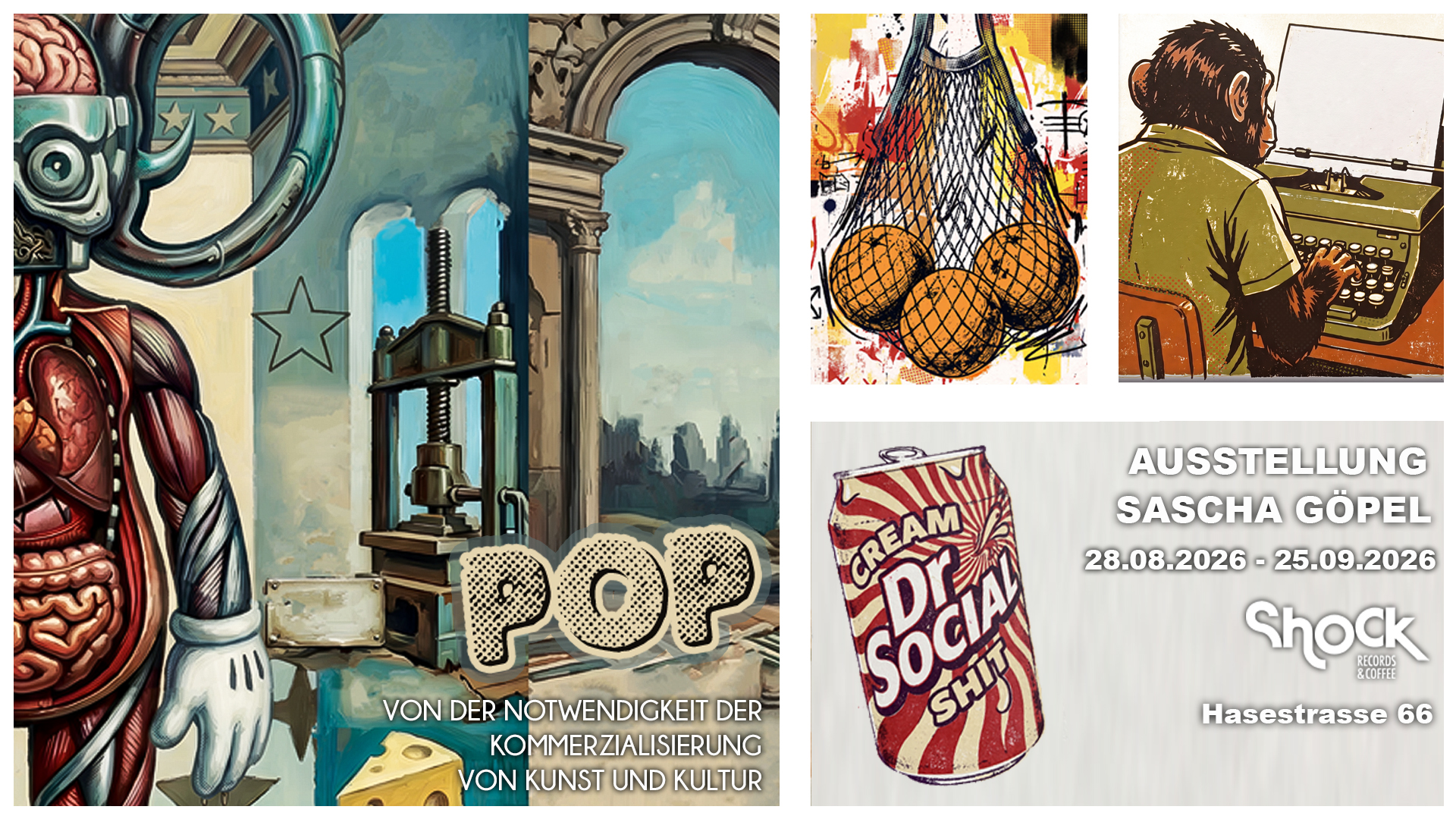
POP – on the necessity of the commercialization of art and culture

“What a Title for an Exhibition.”

At first glance, Sascha Göpel presents a collection of contemporary post-digital collages and prints, drawing on Street Art and similar popular contemporary forms of expression – at times sensationalist, almost provocative, while other works take on a more pop-cultural poster aesthetic.

In his work, Göpel examines the increasing convergence of culture, technology, and economic interests.

His works explore the mechanisms through which emotional experiences, cultural symbols, and natural environments can be reorganized within modern systems of commodification and alienated from their original meaning.

The current exhibition does not mark the beginning of a new artistic direction, but rather the provisional culmination of a long-term development. While earlier works explored individual questions, the present body of work brings together different visual languages within an overarching conceptual system. Digital materiality and the deliberate juxtaposition of historical and contemporary aesthetics form a connecting visual and conceptual framework.

So, what exactly do the individual works have to do with the commercialization of art and culture?

To answer this question, we need to look at the works individually and examine their intentions, as well as the styles and forms of expression they employ, in greater detail.

This is the purpose of this digital exhibition catalogue, which takes a closer look at the individual works, their sociopolitical and cultural context, their techniques, and the processes behind their creation.

2026 ARTS

Digital graphic, DIN B1, CMYK print on 170 g/m² paper. 2026.

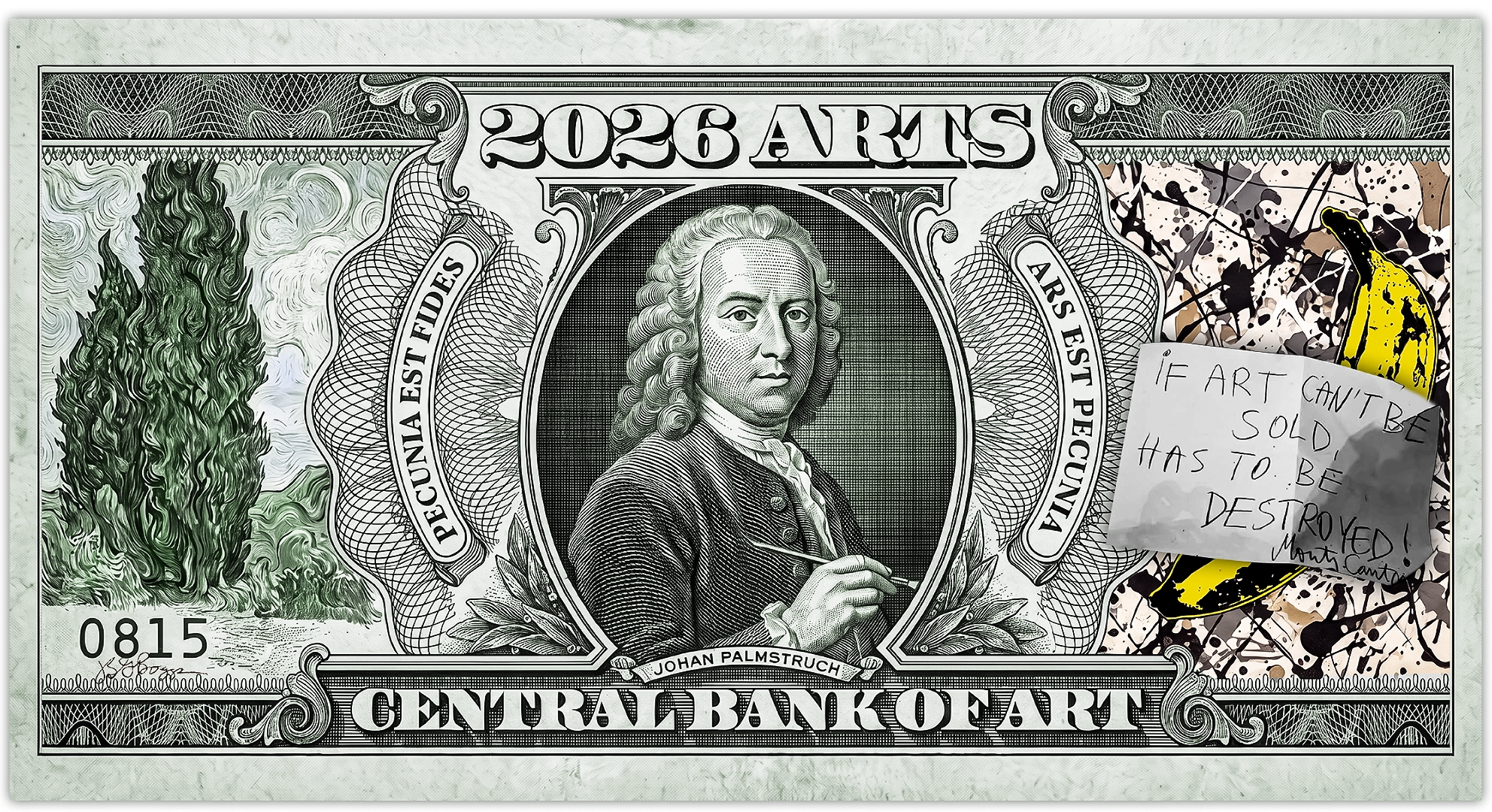
The digital print artwork “Arts” from 2026 explores the absurdity of the art market.

The artist presents various aspects of the commercialization of art in the form of an oversized banknote. By juxtaposing the statements depicted on it, he creates a kind of monetary loop, at the end of which – if one follows the current rules of the art market – the insignificance of unsaleable art must ultimately be accepted, since it generates no financial benefit, while the market alone treats this added monetary value as the basis for determining the cultural value of a work.

At the center of the work, framed by banknote-specific guilloché patterns, we see Johan Palmstruch. Palmstruch was a Swedish banker and the founder of Sweden’s first central bank (1657).

In 1661, he issued the world’s first unsecured banknotes (paper money). Because the bank put too many banknotes into circulation without sufficient precious-metal backing, inflation followed, and the bank was eventually unable to redeem the notes.

Framed by the characteristic flowing patterns of fine lines, we find two Latin mottos. The first is “Pecunia est Fides”, which can be translated as “Money is Faith.” The second is “Ars est Pecunia” – “Art is Money.”

These two mottos clearly illustrate the idea that art only acquires value when people believe in the value of that art. And today, that belief is determined by the market.

Embedded on the left-hand side of the banknote, we see a detail from a work by Vincent van Gogh, who is documented as having sold only a single painting during his lifetime, reportedly for the equivalent of approximately €2,000 to €5,000. Today, however, his paintings command millions at auction.

On the right-hand side, by contrast, we see details of a work by Jackson Pollock, who, through the support of gallerist Peggy Guggenheim, was already able to earn a substantial income during his lifetime. After his death, his works would go on to command immense sums of money as well.

From today’s perspective, Guggenheim’s patronage was probably one of the most successful art investments of the 20th century: her investments of roughly US$20,000 are ultimately estimated to have generated a value of more than one billion US dollars.

Above Pollock’s work, we see the iconic Andy Warhol banana. It represents the ultimate commercialization of art. Warhol was an exceptionally astute businessman. He built an entire art enterprise around The Factory, through which he accumulated a fortune estimated at around US$220 million during his lifetime.


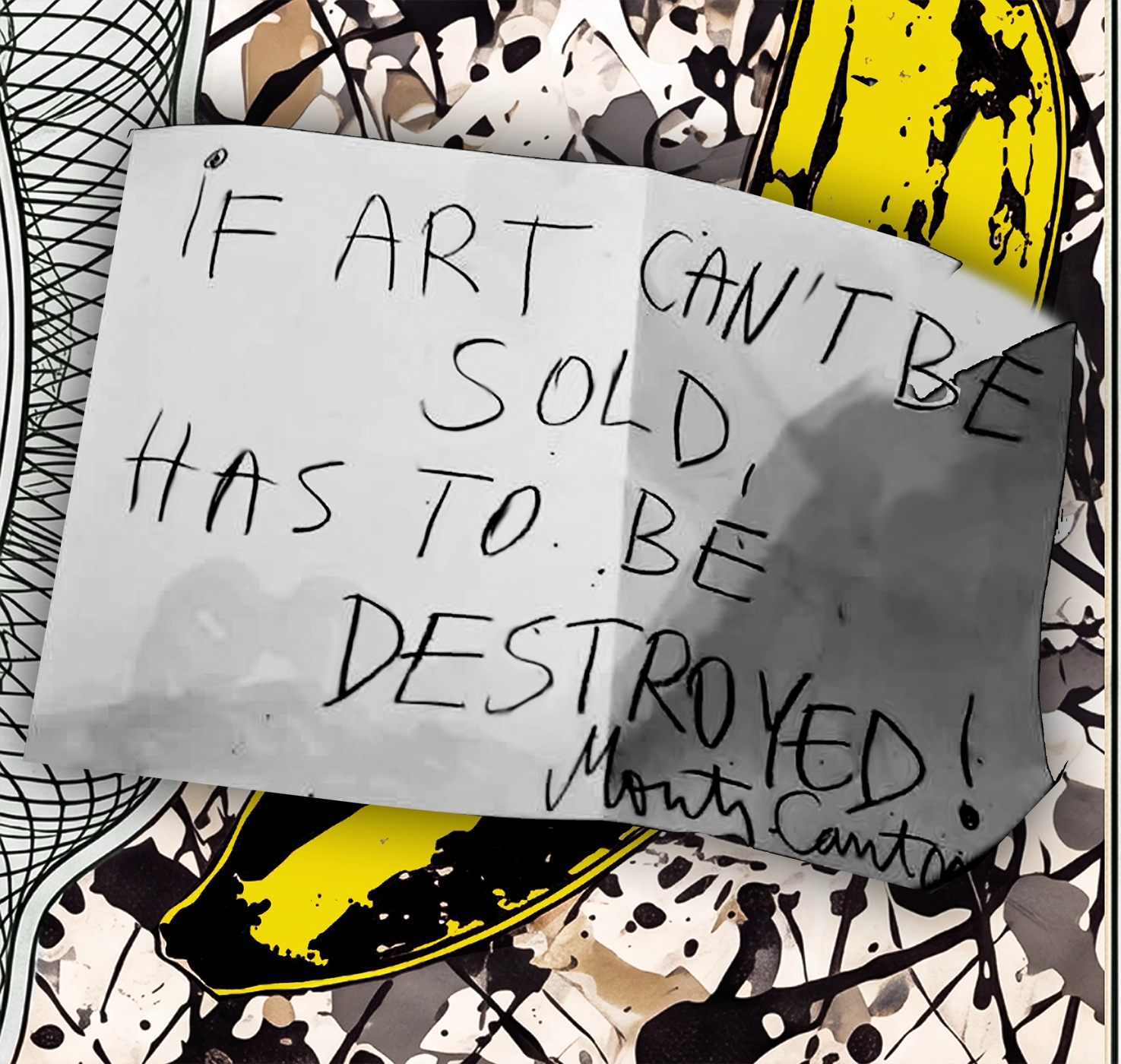
Over these two works, Sascha Göpel places a note attributed to the fictional Neoist artist Monty Cantsin, most famously embodied by Istvan Kantor – the man with the cobalt-chrome teeth, with whom Göpel spent an entertaining evening during the European Media Art Festival in 2015.

It was on that evening that the photograph of this note was taken, bearing the provocative statement “If art can’t be sold, it has to be destroyed.” Ultimately, the statement completely calls into question the absurdity of determining the value of artworks according to their cultural significance, while at the same time exposing the brutality of the contemporary art market in its purely capitalist orientation. In this system, something is considered culturally valuable only when its purchase, trade, and resale promise to generate an appropriate return.

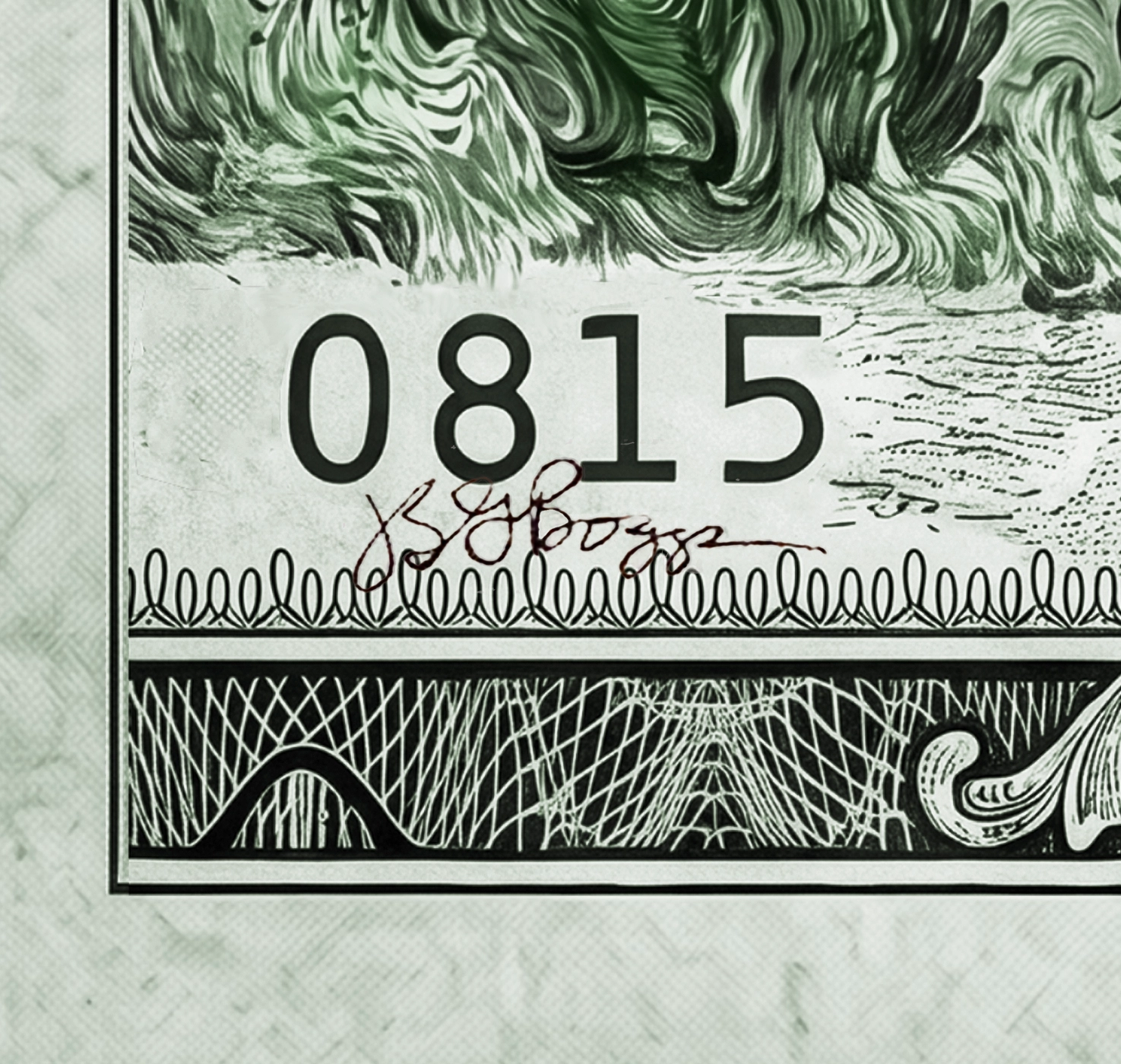
On the opposite side of the fictitious banknote, beneath the serial number 0815, appears the signature of artist J. S. G. Boggs.

In 1984, Boggs made his first transaction involving a banknote he had drawn himself, exchanging it for a cup of coffee. This became the starting point for his attempt to establish his “art” in the form of self-designed paper money as a kind of currency. He was taken to court on several occasions over his work, but was never convicted on charges of counterfeiting.

Unable to successfully prosecute him, the U.S. Secret Service nevertheless confiscated around 1,300 of his works during searches of his home. He would never recover them during his lifetime.

Boggs thus turned his art into a currency that parodied currency itself, and in doing so arguably influenced artists such as Banksy, whose “Di-Faced Tenner” can now be permanently viewed alongside a “5 Pound Boggs Note” in Room 68 of the British Museum.


Over these two works, Sascha Göpel places a note attributed to the fictional Neoist artist Monty Cantsin, most famously embodied by Istvan Kantor – the man with the cobalt-chrome teeth, with whom Göpel spent an entertaining evening during the European Media Art Festival in 2015.

It was on that evening that the photograph of this note was taken, bearing the provocative statement “If art can’t be sold, it has to be destroyed.” Ultimately, the statement completely calls into question the absurdity of determining the value of artworks according to their cultural significance, while at the same time exposing the brutality of the contemporary art market in its purely capitalist orientation. In this system, something is considered culturally valuable only when its purchase, trade, and resale promise to generate an appropriate return.

On the opposite side of the fictitious banknote, beneath the serial number 0815, appears the signature of artist J. S. G. Boggs.

In 1984, Boggs made his first transaction involving a banknote he had drawn himself, exchanging it for a cup of coffee. This became the starting point for his attempt to establish his “art” in the form of self-designed paper money as a kind of currency. He was taken to court on several occasions over his work, but was never convicted on charges of counterfeiting.

Unable to successfully prosecute him, the U.S. Secret Service nevertheless confiscated around 1,300 of his works during searches of his home. He would never recover them during his lifetime.

Boggs thus turned his art into a currency that parodied currency itself, and in doing so arguably influenced artists such as Banksy, whose “Di-Faced Tenner” can now be permanently viewed alongside a “5 Pound Boggs Note” in Room 68 of the British Museum.


C like in Childlabor

PLA 3D print, painted. 2026.

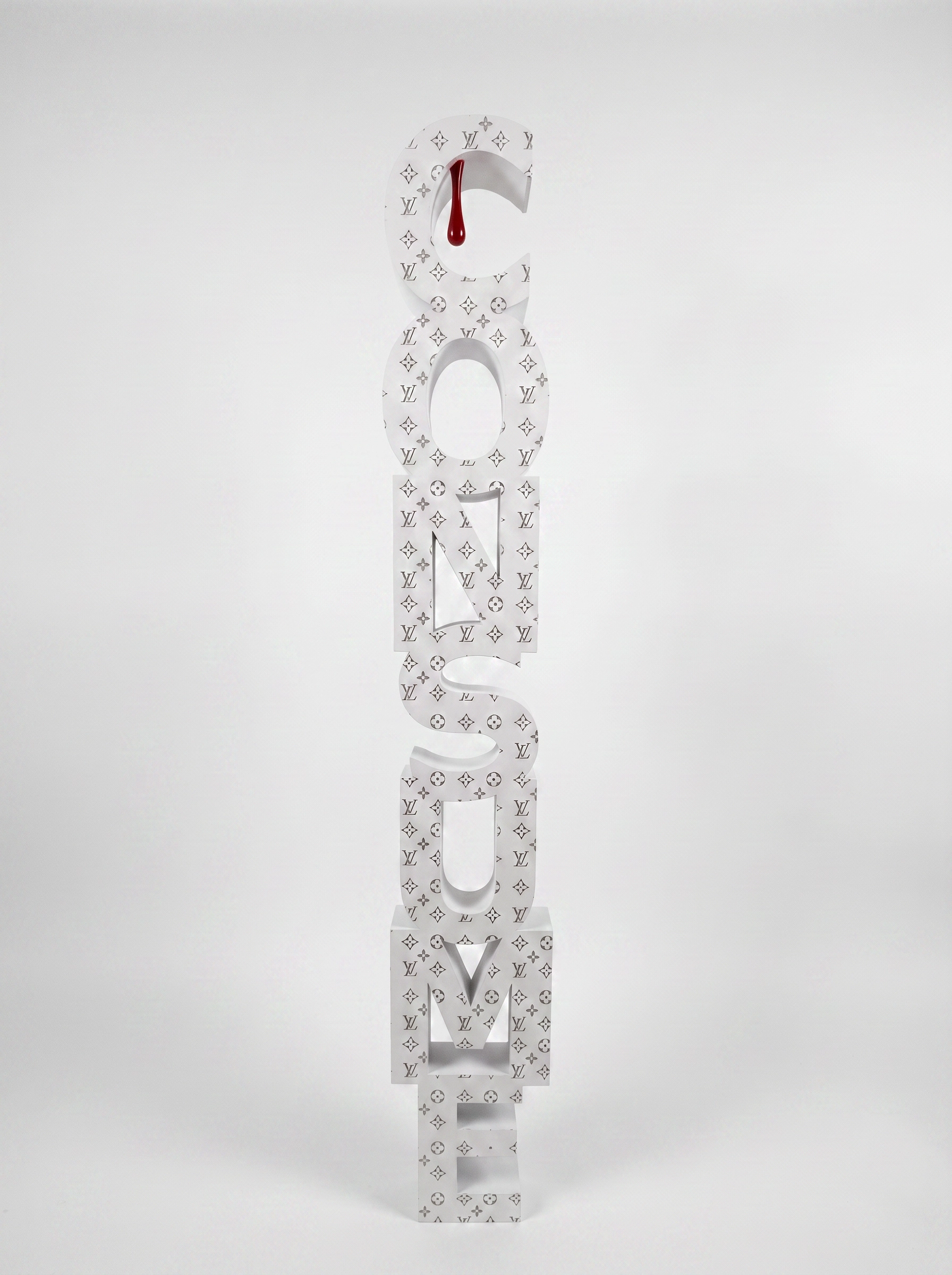
In his first major sculptural work, created entirely in a CAD program, Göpel addresses the cultural dualism of consumption and production. Luxury brands repeatedly come under criticism when it comes to working conditions in global supply chains. Louis Vuitton serves here as a representative symbol of the luxury brands within the LVMH Group and points to the fundamental question of responsibility within global consumer culture. Behind the glossy façade of high-end fashion, one often finds the same bitter reality that has been publicly discussed for years in connection with more affordable brands such as Primark and H&M: inhumane working conditions, inadequate wages, insufficient oversight, and recurring reports of illegal child labor within parts of global supply chains.

Here, consumption, the pursuit of profit, and morality collide directly. Morality is subordinated to the maximization of economic interests. A brand culture that, in Western, capital- and success-driven society, is read as a symbol of power, status, and social belonging stands in stark contrast to the conditions under which these products are made.

The exaggeration embodied in the drop of blood that appears to flow from the word “CONSUME” points to the bitter reality behind this absurd status-symbol industry. The red drop becomes a metaphor for a price that remains invisible in the showroom. It reminds us that behind every perfectly staged brand lies a production chain whose human and ecological costs cannot simply be concealed behind glossy advertising campaigns. The sculpture therefore poses the uncomfortable question of whether luxury is truly an expression of success, or rather the result of a global displacement of responsibility – and, ultimately, a coarsening of our entire culture.

On the one hand, people are conditioned to aspire to the possession of these superficially high-quality yet often overpriced products in order to enhance their perceived value and social standing. On the other hand, there is the invisible suffering to which many of these products owe their existence. Consumption no longer appears here as an individual choice, but as a cultural system that continually reproduces itself through symbols, desire, and social recognition.

The sculpture’s high-gloss exterior attempts to conceal these contradictions. Yet the gruesome reality breaks through the flawless surface and slowly makes its way into the light. The sculpture thus becomes a metaphor for a society in which aesthetics increasingly appear more important than provenance, responsibility, or the dignity of those who make material prosperity possible in the first place.

The luxury of the few is – according to this provocative thesis – purchased through the invisibility of the many. What appears in perfectly illuminated retail spaces as a symbol of exclusivity and success often bears, beyond the field of vision, the traces of global inequality.

As with the Pop Art of the 1960s, the work deliberately draws upon the visual language of global brands. While artists such as Warhol reflected the mythology of the world of commodities, Göpel shifts the focus toward its hidden conditions of production and confronts the viewer with the discrepancy between perfect surfaces and invisible social costs.

Sit still and listen

Digital graphic, DIN B1, CMYK print on 170 g/m² paper. 2026.

The propaganda poster “Sit Still and Listen,” broadly inspired by Soviet poster art and the work of Alexander Mikhailovich Rodchenko, while also incorporating elements of contemporary Street Art, openly criticizes the commercialization of another form of cultural property: music.

More specifically, it addresses modern forms of access to audio entertainment and the associated remuneration models, in which creators are generally compensated with only a fraction of what they might have earned had they still been able to sell physical media.

We see a stylized Soviet worker raising a megaphone into the air, from which sound appears to emerge in a wave-like form.

At the center of the megaphone is the logo of one of the leading streaming platforms, which, in less than 18 years, succeeded in shifting music consumption away from the sale of physical recordings toward internet-based streaming.

With this transition, the remuneration received by smaller, relatively unknown musicians who felt compelled to make their music available on these platforms as well has effectively approached zero.

Songs with between 1 and 1,000 streams per year generate an average of $0.03 per month. If, however, each of those listeners were to purchase a CD, LP, or even a digital download, the revenue from just one song would already exceed one euro.

Further criticism concerns allegations that deliberate manipulation of playlists featuring so-called stock music, including AI-generated music, can increase the platform operator’s own profit margin, as the resulting streams can effectively generate payments back to the platform itself.

A model has thus been created in which consumers are promised enormous returns in the form of virtually unlimited access to music for very little effort – or, if they refuse to pay a monthly fee, are forced to accept audio advertising in the middle of listening to a piece of music. At the same time, the artist’s direct interaction with the consumer has been significantly restricted.

Spotify effectively operates as a kind of reseller, without offering the consumer any physical medium to own. The company can even determine which musicians gain access to this “market” and, through minor changes to its algorithm, can potentially restrict or even eliminate an individual artist’s ability to reach an audience.

Alongside music streaming, Spotify increasingly promoted the distribution of podcasts from 2016 onward, reaching a particular high point at a brunch held one day before Trump’s reelection under the heading “The Influence of Podcasts in This Election.”

Here too, the corporation directly influences the visibility and availability of these sometimes highly political programs, thereby not only influencing voter behavior but also deliberately promoting the political forces and policies that may ultimately help secure its business model.

Göpel demonstrates that the consumer is ultimately expected to simply sit still and listen to whatever is presented to them through the use of opaque algorithms.

The only remaining difference from Soviet propaganda is the possibility of using targeted searches to find more specialized content and thereby maintain a form of consumption that is somewhat more individual than what the system would normally present. But who still has the time – or the inclination – to do so?

In the end, as always, what remains is the computer-driven capitalization of yet another form of art, designed to systematically shift wealth away from consumers and creators and toward those who own and control the markets.

Never trust the mouse

Digital graphic, DIN B1, CMYK print on 170 g/m² paper. 2026.

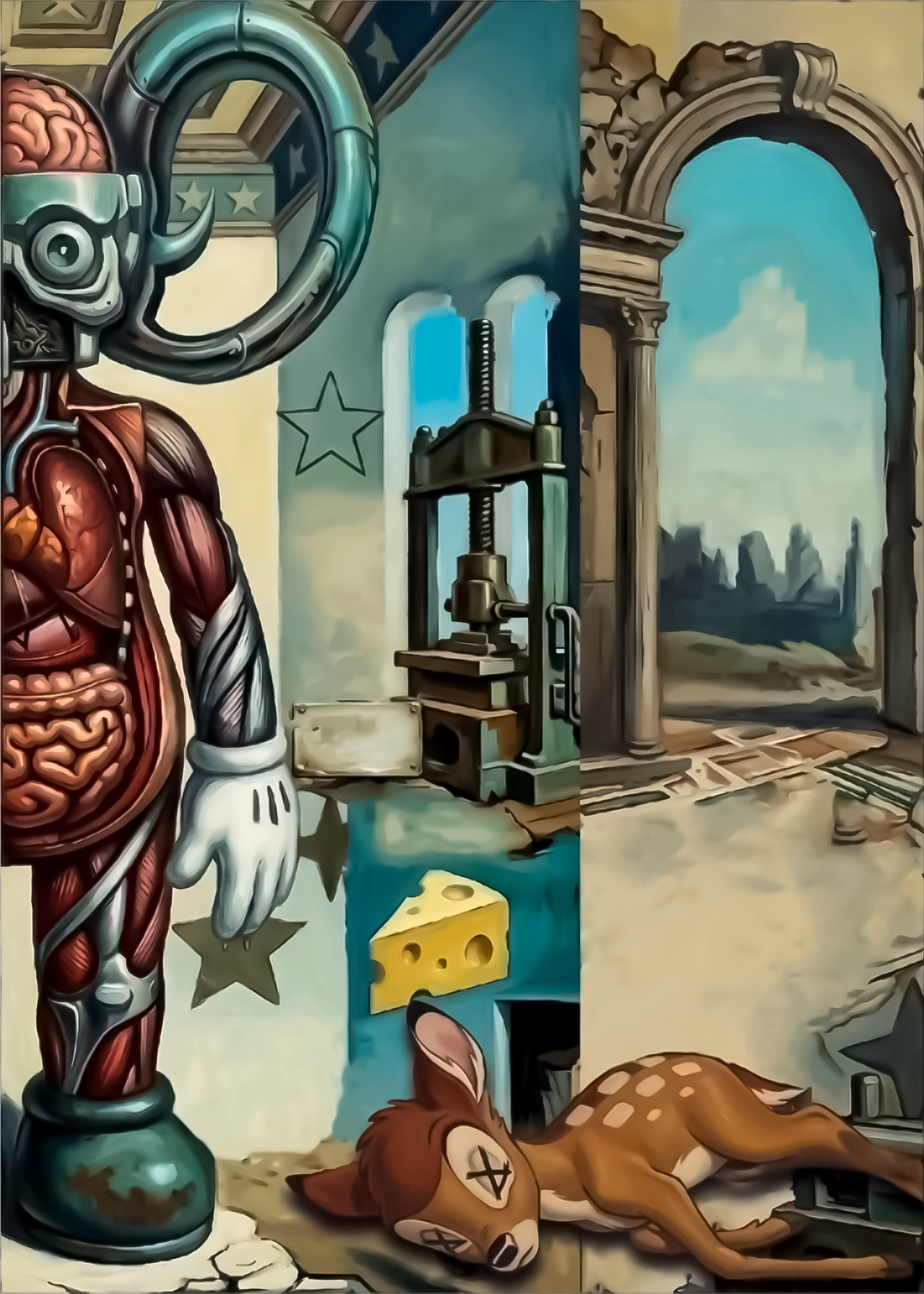
“Never Trust the Mouse”, because the mouse deliberately kills parental figures in its animated films for children in order to create an emotional bond with the surviving characters, which in turn helps sell more merchandise to those same psychologically traumatized children.

In his poster print, influenced by post-socialist realism and the New Leipzig School, Göpel symbolically highlights these very aspects of the commercialization of emotions generated through art.

On the left, we see a Mickey figure rendered in the style of contemporary Art Toys, drawing on the visual language of Brian Donnelly (KAWS Companion Flayed). The interior of the mouse is exposed like an anatomical model. Instead of the expected bones, however, we find steel and skull elements more reminiscent of the inside of a robot. Beneath its skin, the mouse is depicted as a hybrid of organic matter and technology, giving its original appearance an entirely new meaning.

Instead of a funny, lovable cartoon character, we see a technology-driven human-machine hybrid whose exposed core reveals an entirely different image.

The artist deliberately retains the white gloves, because Disney already understood their significance: from the 1920s onward, white gloves were perceived as a symbol of elegant performers, magicians, waiters, famous entertainers, and similar figures. Anyone wearing such gloves was expected to be someone special and was rarely suspected of having malicious intentions at first glance.

At the lower right edge of the image, Göpel shocks us with the placement of an apparently lifeless young animal figure, recognizable as the protagonist of the film “Bambi.”

Here, it is not the parent who dies; here, innocence itself dies before it can even embark on its hero’s journey. A part of that innocence is sacrificed so that the suffering created by its loss can be turned into profit.

Cheese, together with the printing press positioned at the center of the image, reveals the mouse’s true intention: it wants cheese, but what it really wants is money.

The entire background composition consists of a beautifully proportioned interior space on the left, punctuated by neoclassical arches that open the view toward a gray, almost ruined exterior world on the right.

The experience of an innocent child traumatized by such an animated film breaks through that previously intact interior, tearing holes into the child’s psyche and forcing a view of the outside world that, at this stage of life, might otherwise have been avoided.

Bambi itself functions here merely as a symbol of a narrative device repeatedly employed from this film onward: backstory – death – hero’s journey – happy ending. Over the following decades, this formula was continually expanded and, from the 1980s onward, increasingly deployed as a form of consumer psychology directed at parents, helping the mouse build its kingdom.

Disney systematically employed this strategy over many decades. Walt Disney was convinced that emotional identification was the key to a good story.

The commercial success of merchandising, which had already begun with Mickey Mouse products as early as 1930, subsequently grew out of this emotional attachment.

Immediately following the release of these animated films, picture books, stuffed animals, figurines, puzzles, coloring books, and countless other products were brought to market, monetizing and exploiting the emotional bonds created during these often disturbing cinematic experiences.

Here too, art was deliberately used as a means of generating capital – this time even through the use of emotional cruelty at the expense of innocent children.

Consider in this context the animated feature “Frozen,” in which the parents of the two young protagonists die only around 10–15 minutes after the beginning of the film. The fact that the film generated approximately US$1.3 billion in theatrical revenue and subsequently led to several billion dollars in merchandising revenue – through dolls, costumes, school bags, bed linen, and countless other products – illustrates the scale of this commercial model.

Naturally, Disney is also investing heavily in AI, with the aim of reducing production costs, improving visual quality, completing films more quickly, and reducing staffing requirements.

Göpel shows us that the mouse still possesses organs that keep its technological exoskeleton alive, while simultaneously suggesting that this may soon change – and that what once began with art could ultimately evolve into a soulless, entirely commerce-driven automated production apparatus.
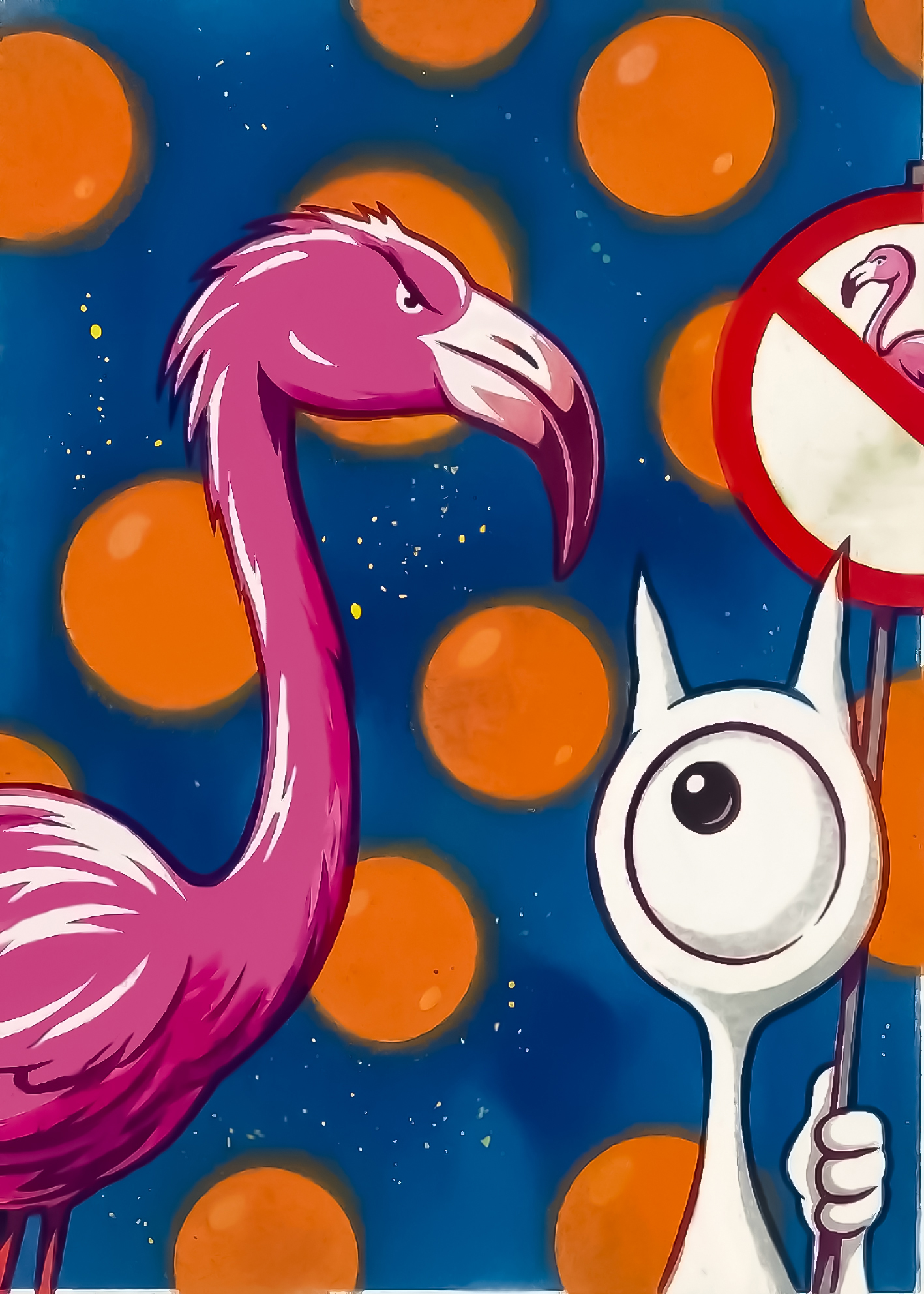
Flamingos nicht erwünscht

Digital graphic, DIN B1, CMYK print on 170 g/m² paper. 2026.

In a digital remake of his acrylic painting “Flamingos Not Wanted,” first exhibited in 2018, Göpel presents a confrontation that, in the years that followed, would recur almost every other day in everyday life, as well as in the press and on the internet.

The rejection of the white, cartoon-like figure on the right, holding a sign in the style of a general prohibition symbol according to ISO 7010, with the flamingo depicted on it facing the figure directly, is unmistakable.

The expression on the protester’s face – if one can speak of a face in this case – appears rather anxious and bewildered. Instead of a mouth and nose, the figure possesses little more than a single large eye, apparently unable to comprehend the fact that the object of its protest is actively confronting it.

On the left, by contrast, we see a flamingo: larger, prouder, and far more imposing than the small white figure protesting against it.

It remains unimpressed, looking down at its diminutive counterpart with an expression that is both slightly angry and sternly disapproving.

In contemporary art, the flamingo has acquired new positive associations with love, joy, sensitivity, and elegance, making it an extremely popular motif that, from the 2010s onward, would almost come to dominate popular culture in a wide variety of forms.

Its cyclopean antagonist, by contrast, appears colorless and simplistic and, with its single eye, seemingly incapable of grasping the situation in its entirety.

The difference in scale is deliberate: the protesting party is small; the object of its protest is large.

In the background, which, like the rest of the poster, is rendered in a kind of risograph-like texture, we see orange spheres against a deep blue field.

In 2018, orange and blue still served as visual stand-ins for two political parties that had only recently brought xenophobia, debates surrounding migration policy, and social division back into the reality of German society. Now, just eight years later, the image appears more relevant than ever.

What is already hinted at here would subsequently become an everyday reality, particularly on social media.

Small groups became increasingly radicalized and now openly carry the system of values that began as protest into the center of society as an ideology.

The diverse society confronting them, generally more concerned with harmony and peaceful coexistence, is visibly losing patience in the flamingo’s eye and is beginning to question whether peaceful resistance is still an adequate response.

The remake was initially intended to bear the title “No Fear,” but Göpel ultimately and deliberately chose to abandon it. He does not regard crossing the threshold toward the final, potentially radical means of direct physical retaliation as an appropriate response for a fundamentally peaceful center of society. Yet through the deeply concerned expression of the large pink bird, he nevertheless introduces the possibility that it may already have to contemplate such a confrontation in the near future.

The struggle over interpretive authority regarding the foundations of a culture, and the shifting of those values driven by technology and the media, has not yet been lost. But it is being fought out every single day, even in the smallest encounters.

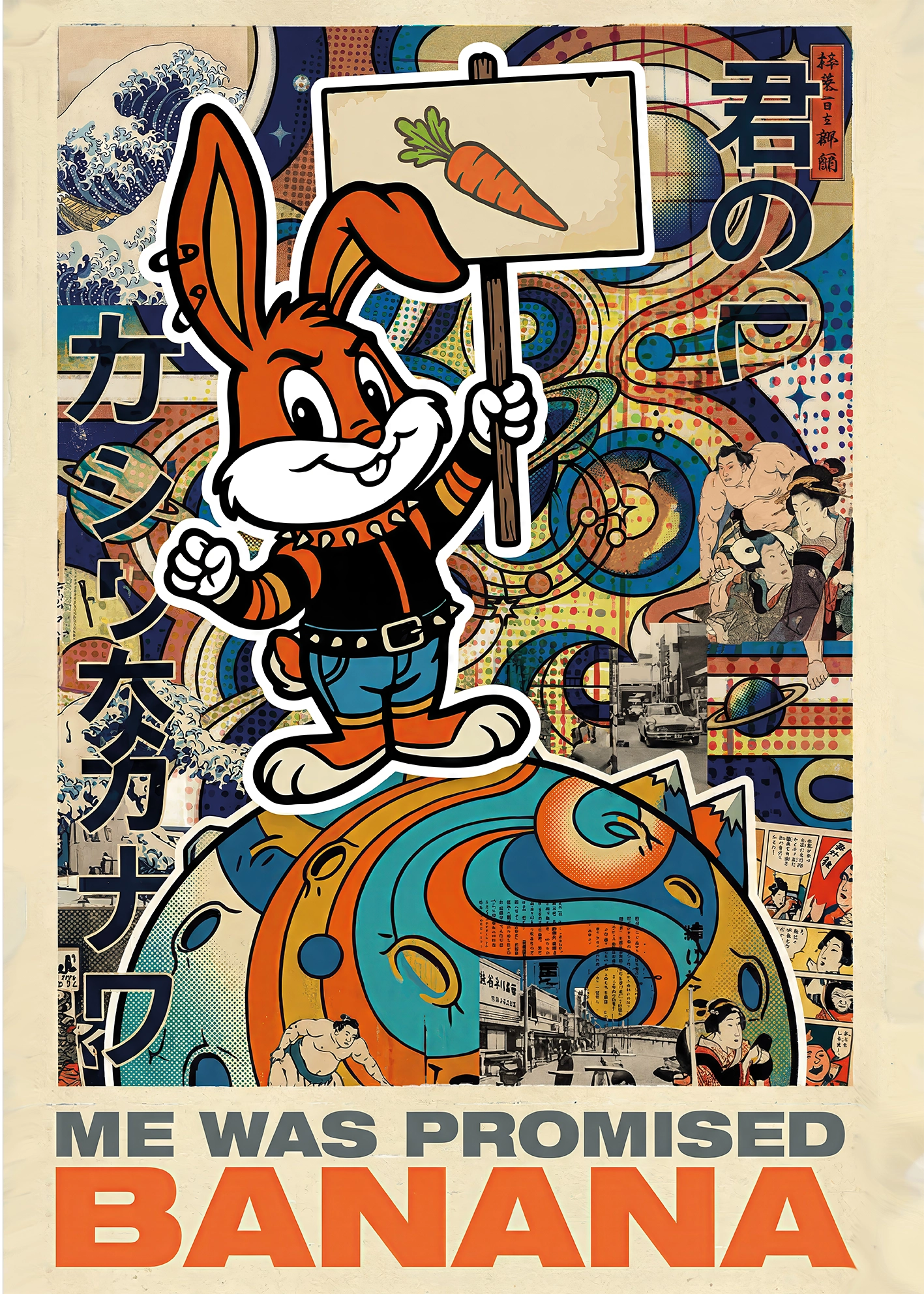
Me was promised banana

Digital graphic, DIN B1, CMYK print on 170 g/m² paper. 2026.

Already during one of his previous exhibitions, titled “COPY COPY is Not Art from China,” Göpel presented a motif entitled “Me Was Promised Banana.” At the time, the work was more informal in nature, with a tongue-in-cheek reference to working conditions. He now develops a new and far more comprehensive visual theme around this statement.

As in the adjacent poster “Flamingos Not Wanted,” we see open protest. This time, however, it is directed explicitly at the viewer, and therefore at society as a whole. The protagonist, an orange cartoon rabbit dressed in a typical punk-rock outfit, appears to be searching for his place in the universe, embedded within a collage of Japanese woodcuts, 1960s newspaper clippings, comic-book pages, and vector-based science-fiction imagery. He defiantly raises a sign bearing the image of a carrot.

The deliberately overloaded composition initially creates a sense of disorientation. Only at the bottom edge of the image is it framed by the titular statement, which reveals that bananas had actually been promised.

Göpel thus appears to be exploring the theme of an unfulfilled promise. He deliberately places his composition within a visual language that combines both traditional and contemporary Japanese printmaking.

Japan, with its striking dualism between tradition and modernity, serves here as a symbol of current global developments in which technology and established social norms collide, raising questions about the value of preserving historically rooted cultural forms and practices.

It seems entirely normal, for example, that Japan develops industrial robots for the global market and autonomous vehicles for future lunar missions, while everyday business practices still rely on handwritten stamps (Hanko) for official documents.

There have certainly been areas in which Japan embraced grand visions of the future. As early as the late 1980s, household robots were being promised; from 2001 onward, the transformation toward a Hydrogen Society was actively promoted through the increased use of hydrogen; and even the large-scale development of nationwide magnetic-levitation railway networks was undertaken.

Yet all of this fell far short of the original expectations. Bananas were promised, but carrots remained the reality, as always.

Our protagonist therefore stands caught between expectation and reality and appears to be protesting. Clearly defining himself as an individual, he seems to be demanding a promise that, surrounded by established sociocultural structures, continues to elude him.

All of this can be read as a question of whether it is actually sensible to abandon cultural achievements and invest blindly in future technologies, or whether it may sometimes be wiser to retain old structures that have evolved over centuries and survived countless waves of change.

Between woodcut, newspaper print, and contemporary digital vector graphics that imitate the aesthetics of screen printing, our rabbit stands demanding bananas – without realizing that the very bananas he is demanding might, in the long run, actually be more harmful to his organism than the carrots he has been given.

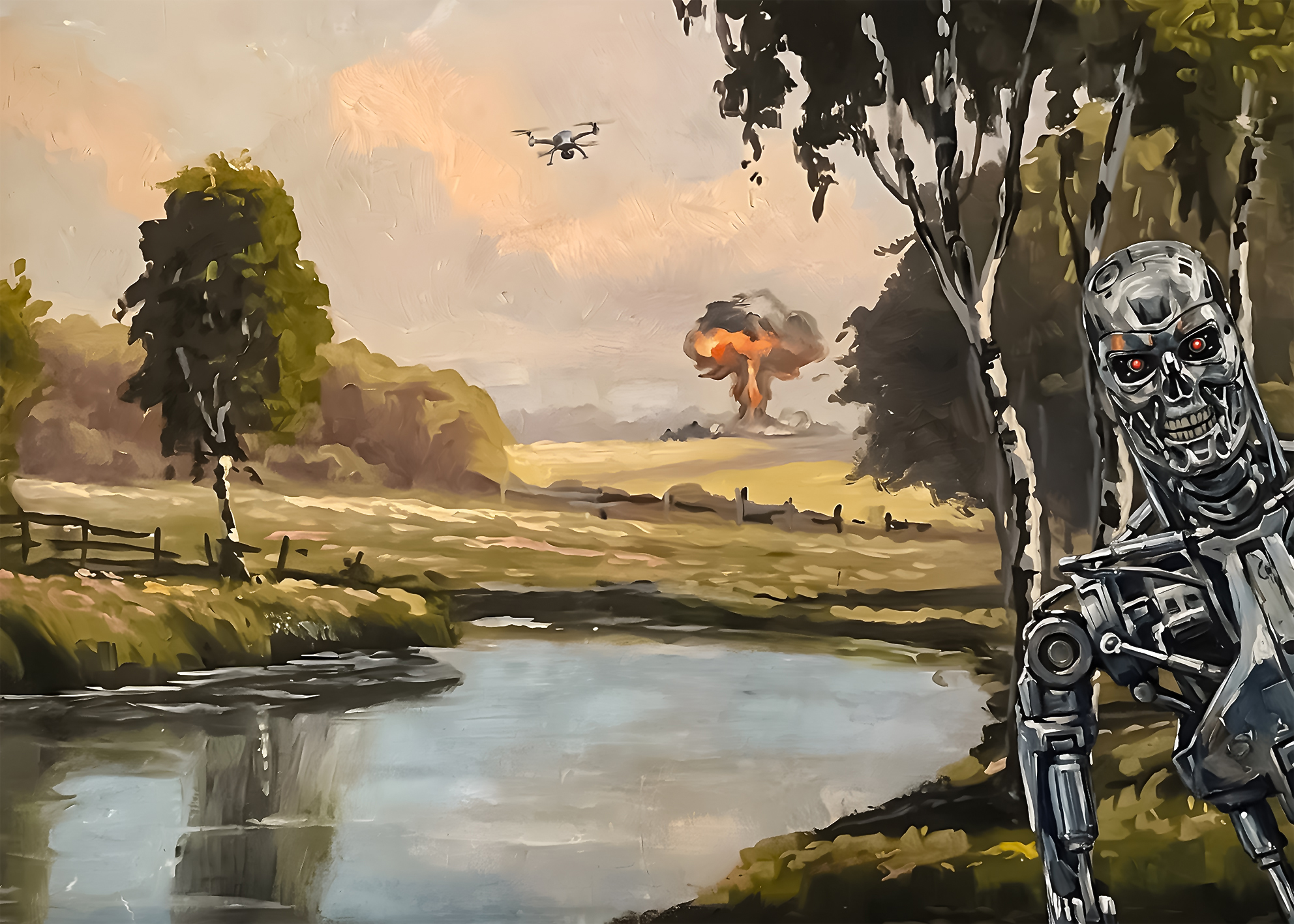
Unterlüß

52.921816308060166,

10.288613108632804

Digital graphic, DIN B1, CMYK print on 170 g/m² paper. 2026.

Developed as an artistic form of expression within Dadaism and Surrealism in the 1920s, overpainting was used to alter the manifest visual message of artworks or photographs.

Göpel takes a landscape painting of the Lüneburg Heath typical of the late 1940s as his starting point and, through overpainting, places it within a new, contemporary context.

We see destructive technology invading the natural landscape, not merely threatening it but beginning to destroy its habitat.

Unterlüß lies in northeastern Lower Saxony, on the eastern edge of the Südheide Nature Park. Göpel establishes an explicit geographical line of sight here, based on latitude and longitude.

The viewer is placed directly in the Unterlüß Testing Center (EZU), the largest privately operated military testing and trial area in Europe. Here, Rheinmetall conducts extensive testing of systems and components for national and international customers from both the military and civilian sectors. Rheinmetall has operated explosives testing grounds, firing ranges, and other testing facilities at this location since 1899, predominantly for military purposes.

Only around 20 kilometers to the northwest, the Dethlinger Teich was used after the Second World War as a disposal site for the neighboring Oerrel Air Force Main Ammunition Depot (Muna). After the war, the British dumped there remaining ammunition that could no longer be transported, followed by additional chemical warfare munitions. It is likely that some of this ammunition included shells whose casings originated from Unterlüß.

During current recovery operations, 10.5 cm and 15 cm artillery shells, bombs, mines, and tens of thousands of detonators have been found, among other items. Most were filled with chemical warfare agents.

Particularly significant is the fact that remediation work is currently also being carried out on contaminated sites belonging to Rheinmetall in Unterlüß. The work is prompted by suspicions that residues from the dismantling and disposal of chemical warfare agents were buried there during the First and Second World Wars.

The apparently untouched cultural landscape is therefore revealed as a space that has been used for destructive developments, while the resulting dangers to human life and public safety have effectively removed parts of it from public access.

Göpel thus demonstrates how nature has been consciously sacrificed to the pursuit of profit by arms manufacturers for more than a century.

How they killed anonymity

Digital graphic, DIN B1, CMYK print on 170 g/m² paper. 2026.

In his digital print “How They Killed Anonymity,” Göpel shows us a murdered German telephone booth from the late 1980s.

With the abolition of coin-operated public telephony, citizens were deprived of the ability to make anonymous telephone calls.

On November 21, 2022, the coin acceptance function of all remaining public payphones was deactivated remotely.

This date can, in a sense, be seen as marking the beginning of the widespread normalization of warrantless, identity-linked telephone surveillance, since from that point onward it was no longer possible to make a telephone call without leaving a traceable, personalized digital footprint.

From November 21, 2022 onward, the remaining phones could only be used with prepaid phone cards or credit cards.

The press contacted Telekom and requested information about the locations of public telephones.

However, company spokesperson Pascal Kiel-Koslowski responded rather tersely: “We no longer maintain regional data on telephone booths for external communication.”

In plain terms: Telekom did not want to disclose the locations. No reasons were given, even when the company was asked again.

The approximately 12,000 remaining public telephones were dismantled by mid-2026.

The intimacy of telephone conversations has been dead since the world began making calls by mobile phone everywhere and at all times. The boundary between private and public has dissolved when the most intimate matters are discussed openly in front of an audience: when relationships are laid bare to the left in a fully occupied ICE train, while business affairs are loudly conducted on the phone to the right.

In 2025 alone, government agencies made more than 35 million requests to determine who was associated with a particular telephone number. The number of such requests has doubled within five years.

Who owns a telephone number? 135 government agencies can obtain this information from 142 telecommunications companies, without the affected companies or customers necessarily being aware of the inquiry.

This automated information system is operated by the German Federal Network Agency (Bundesnetzagentur) and is also known as the “Behördentelefonbuch” (“government telephone directory”) or Bestandsdatenauskunft.

Göpel demonstrates how the disappearance of a cultural institution such as the telephone booth also coincided with the disappearance of a certain form of privacy – and how citizens seemed willing to simply accept this because it was supposedly so much easier to carry their own personal listening device around in their jacket pocket at all times.

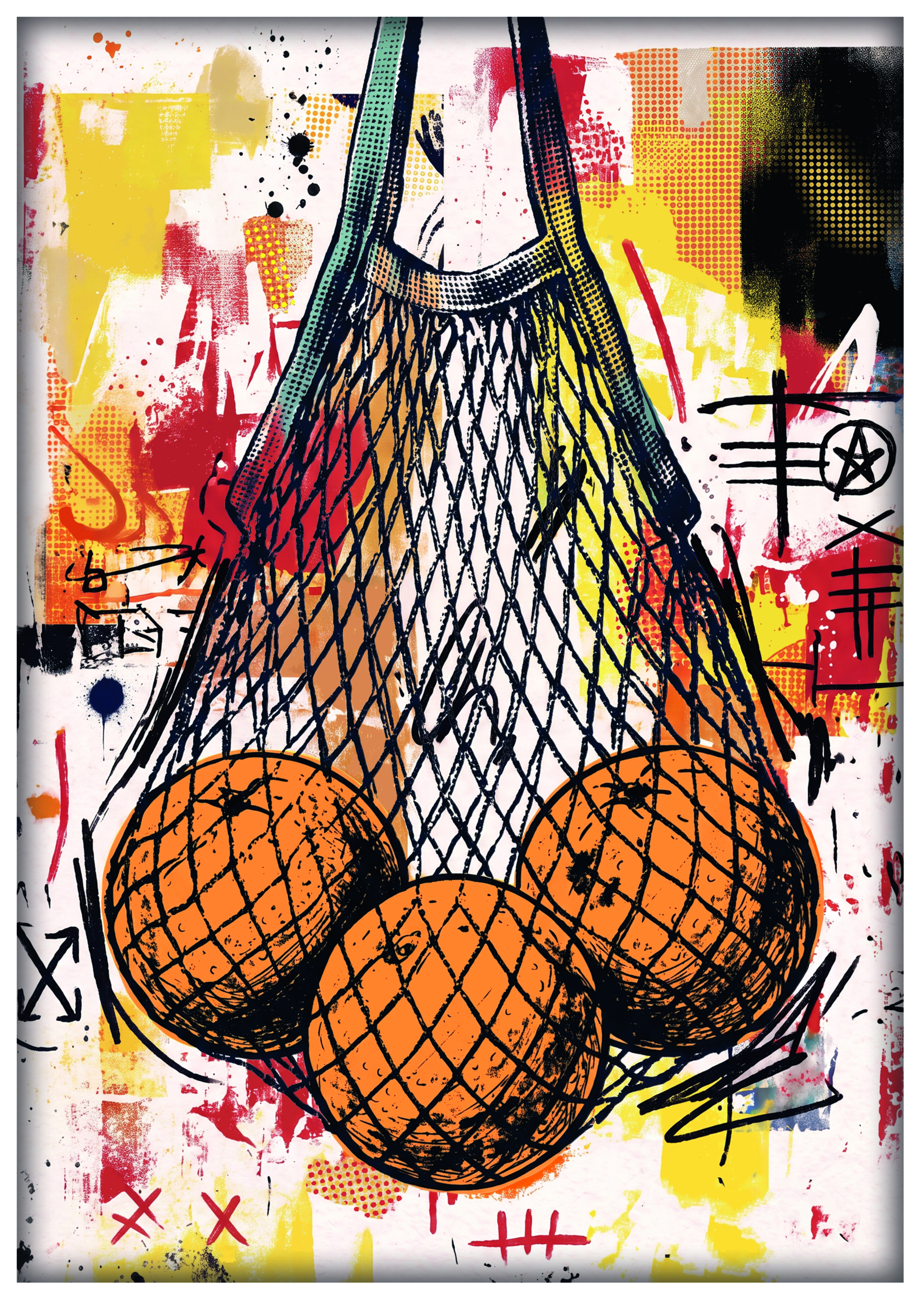
Wenn Andy Orangen verkauft hätte

Digital graphic, DIN B1, CMYK print on 170 g/m² paper. 2026.

What would Andy Warhol have printed if he had grown up among the undocumented farm workers around Los Angeles?

The significance of the banana artwork extends far beyond its visual appeal; it represents Warhol’s fascination with the intersection of art, music, and the avant-garde. Warhol’s collaboration with The Velvet Underground embodies the spirit of experimentation and innovation that shaped the cultural landscape of the 1960s.

Long after his death in 1987, Andy Warhol’s banana continued to generate controversy. In 2012, Lou Reed and former Velvet Underground member John Cale sued the Andy Warhol Foundation for the Visual Arts in New York in an attempt to stop an alleged plan to license the banana image for iPad accessories.

Göpel now replaces the banana with oranges, placing them against a stylized Basquiat-inspired background.

But if Warhol had actually turned his attention to the orange, he might have seen something more than just a fruit. He might have seen the undocumented Mexican immigrants standing by the roadside, trying to earn a living from the oranges grown under inhumane conditions in Orange County.

So would Andy have sold oranges? And how much would Andy’s oranges have cost?

The fact that an image of a fruit can become priceless art on the one hand, while the actual fruit on the other is barely enough to keep the person who harvests it from going hungry for a day, reveals the ultimate condition of capitalism.

The image of the fruit becomes a commodity whose value has become completely detached from its actual utility. The banana can become a multi-million-dollar work of art, while the orange is worth little more to the person who harvests it than the wages earned for a day’s labor.

For the owning class, the image of the fruit can generate unimaginable returns, while those who actually grow and harvest the fruit struggle to survive by selling their labor.

So would Andy have sold oranges?

Yes. He would have.

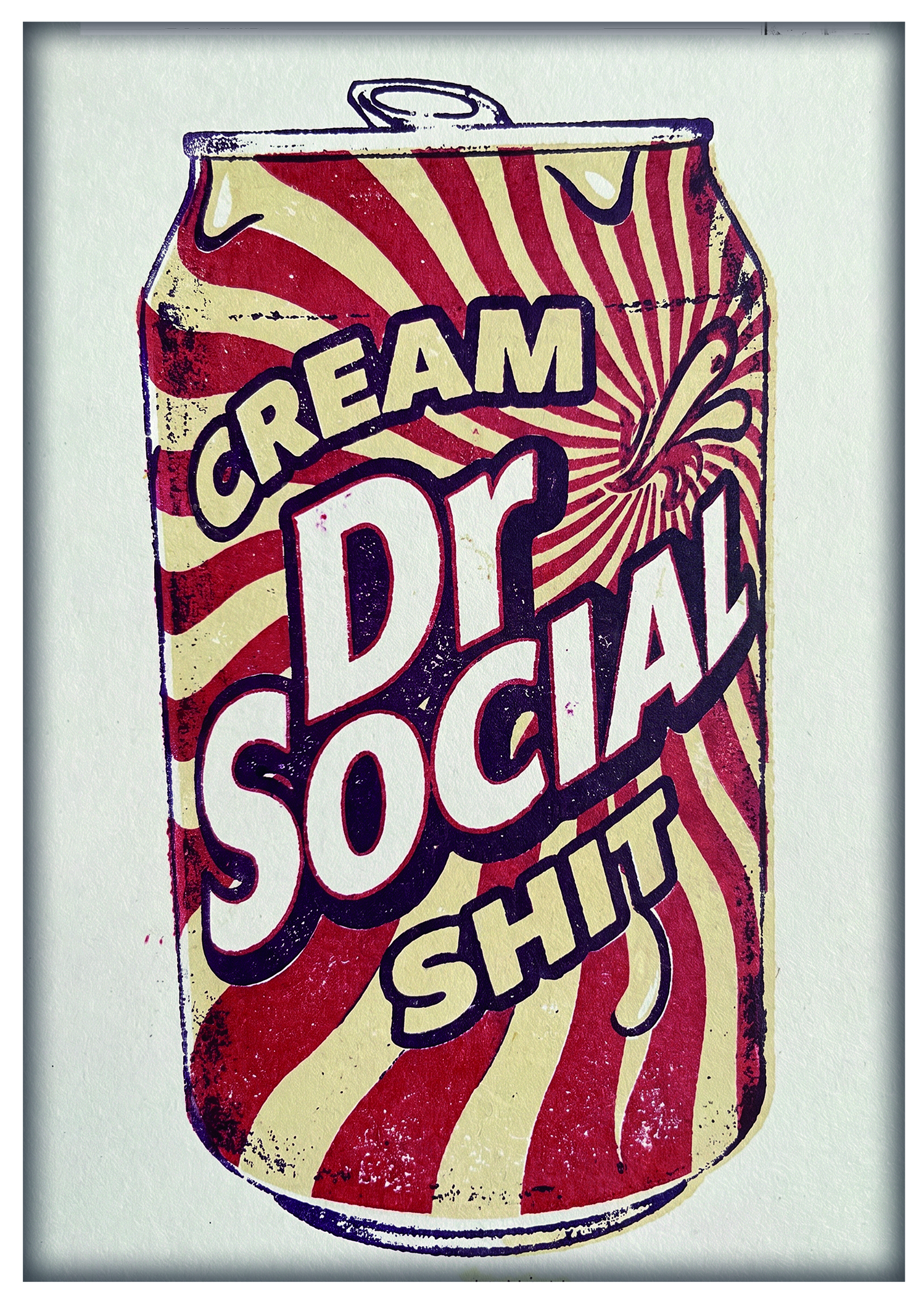
Your daily can of shit

Digital graphic, DIN B1, CMYK print on 170 g/m² paper. 2026.

The beverage can, beautifully printed and designed to carry delicious, sugary drinks, is opened once, after which its contents are meant to be consumed relatively quickly.

You cannot really close such a can again.

Göpel’s can suggests that the manufacturer, Dr. Social, is selling “Cream Shit.”

Clearly, this is an allusion to social media and the churned-up garbage of content that is served to us every day once we have opened the can.

The can is beautiful. We buy it because we have been conditioned to associate it with refreshment and pleasure: that one moment in the day when we allow ourselves a little indulgence.

Yet the sugar content and other ingredients seem designed primarily to sell us more and more of this concoction, gradually making the consumer dependent on it.

This is also how the system of social media works: once opened, it attempts to keep the participant engaged, using algorithmically generated streams of content to provoke emotional reactions, encourage further consumption, and eventually trap users within so-called bubbles.

And even when we are aware of how the system works, we are not immune to falling prey to it.

The structure of social media is so insidious that it exploits our fundamental human desire to communicate, only to use the back door to introduce content that can be understood as nothing more than an attempt to influence opinions.

“Give us this day our daily bread” thus becomes:

“Give me my daily dose of hatred, outrage, validation, and digital approval.”

Is this really the cultural consensus we have agreed upon as a society? A form of communication in which we feed one another hatred, outrage, and validation every day and call it social interaction? Or have we simply forgotten that we ourselves could decide how – and what – we want to communicate with one another?

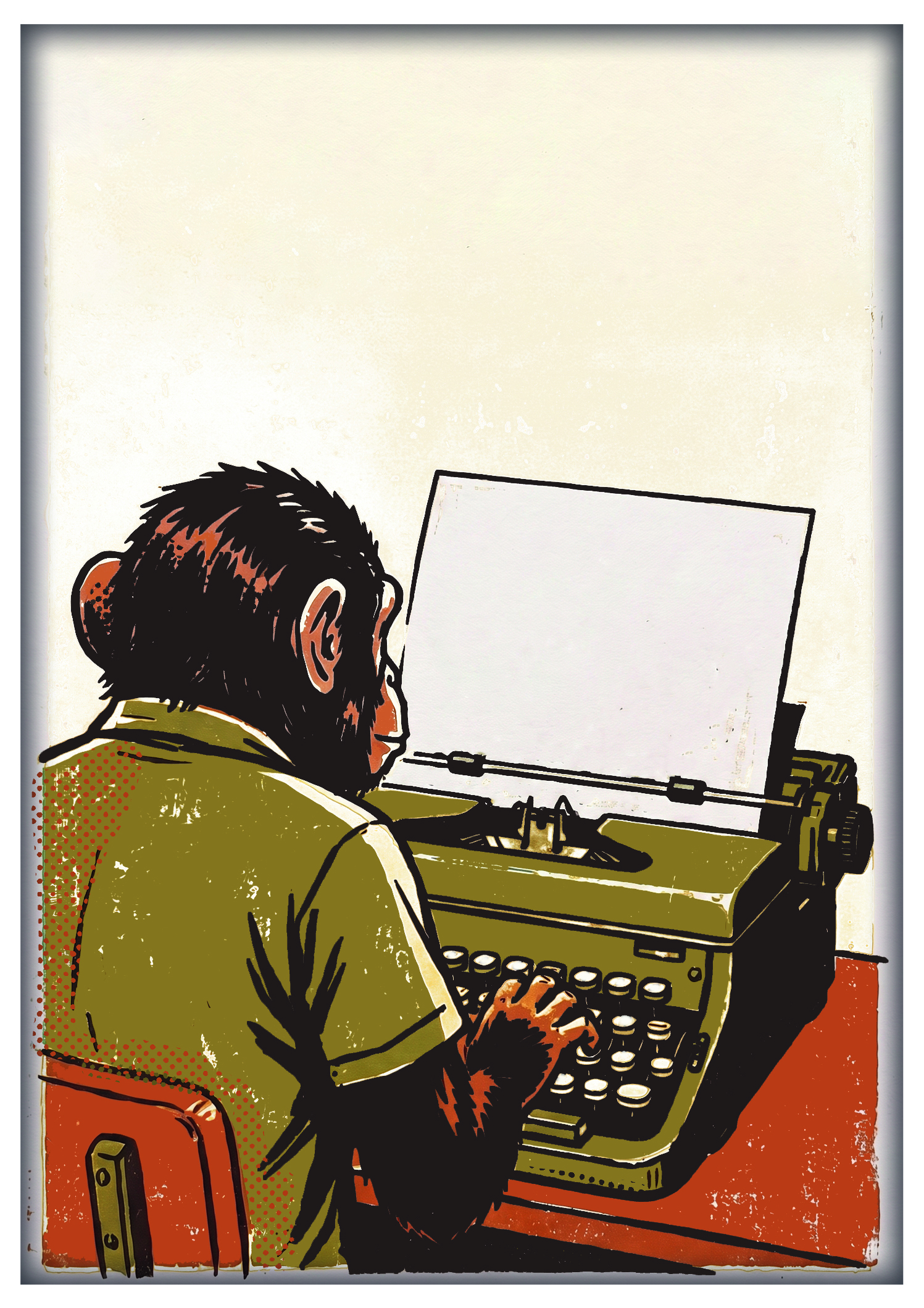
Die Angst des Affen vor dem leeren Blatt

Digital graphic, DIN B1, CMYK print on 170 g/m² paper. 2026.

In his novel Fool on the Hill, Matt Ruff has monkeys sitting at typewriters. They type away with all their might, and somewhere between chance, persistence, and the sheer quantity of characters produced, a story might eventually emerge. It is a clever literary inversion of the old thought experiment: if monkeys hammer away at typewriters for long enough, eventually Shakespeare will emerge.

Humankind invented the typewriter, then the computer, word processing, and finally artificial intelligence, so that it could delegate thinking, formulating, and inventing as well. Every new machine promised greater freedom. And indeed, each one reliably freed us from more and more activities in which we might otherwise have had to confront ourselves.

Because the real problem is not writing.

The real problem is the blank page.

It demands a decision, a thought, a position. Perhaps even something of your own. The blank page is merciless because it contains nothing yet. It cannot claim that the text is bad before it has been written. It can only wait for someone to place the first letter upon it.

So the monkey sits in front of it and waits.

And eventually, artificial intelligence arrives.

It begins writing willingly. It knows Shakespeare, Ruff, and presumably a thousand variations of everything that has ever been said about the blank page. It produces sentences, images, music, and ideas without having to experience the fear that makes human beings recoil from their own ideas.

The monkey has finally found a solution.

It no longer has to think for itself.

It only has to choose.

Perhaps this is the final cultural development in the late stage of late capitalism:

The monkey uses technology to overcome its own inability to produce an idea.

The page does become filled. But in an eternal cycle, it merely replicates what has already been written, thought, and produced. The monkey mistakes repetition for creation and selection for creativity.

And while it waits to finally produce something unique, it fails to notice that it is already sitting at its typewriter again.

Only this time, another hand is pressing the keys.

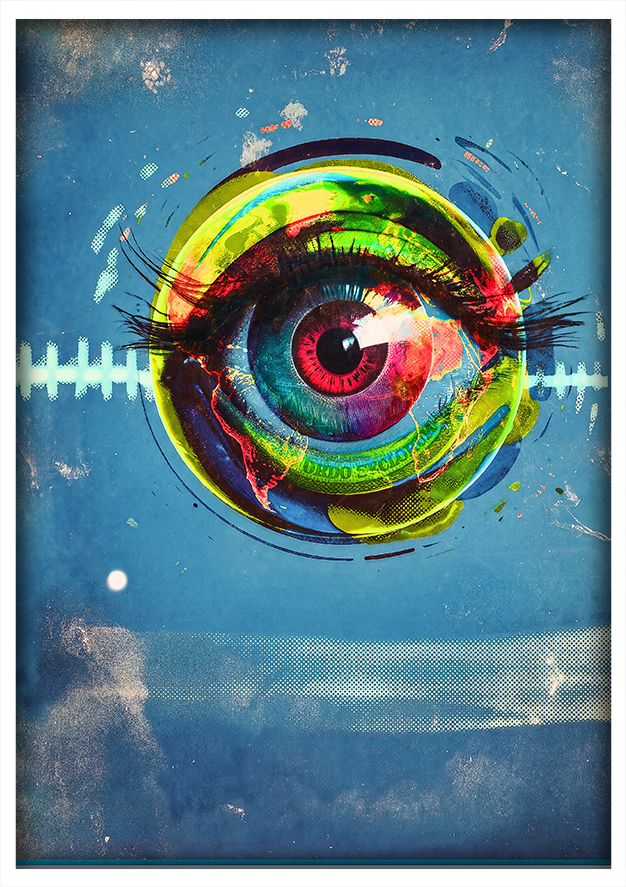
The Iris of the World

Digital graphic, DIN B1, CMYK print on 170 g/m² paper. 2026.

The eye is one of the oldest symbols of perception, knowledge, and control.

What once could merely see can now store, analyze, and connect information.
Our view of the world is no longer entirely our own.
Smartphones, cameras, search engines, and digital platforms accompany us through everyday life, leaving behind a trail of locations, interests, contacts, and habits.

Here, in one of his characteristic digital prints inspired by the aesthetics of screen printing, Göpel shows us the iris of the entire world: the opening through which everything perceptible must pass.
The great filter that now lies in the hands of a few tech bros in Silicon Valley.

Like the Eye of Sauron in The Lord of the Rings, this single eye no longer seems entirely fictional, but already appears to cast its all-encompassing gaze into every corner of our private lives.

Privacy does not disappear with a bang. It is made invisible piece by piece – in the name of convenience, security, and personalisation. We become accustomed to something reading along, listening in, calculating, and remembering.

Suddenly, a license-plate scanner is installed.

All of a sudden, there is a camera mounted on the wall of a building.

And the weird guy next door is suddenly wearing META surveillance glasses on his nose.

And while we believe we are looking at the digital world, the digital world has long been looking at us.

“Ordo Seclorum” – an order of the ages – appears faintly along the lower eyelid like a cipher.

Whether it represents the promise of an ordered world or a symbol of a power that seeks to keep everything under observation, the eye remains wide open and continues to watch.

All information is viewed through the eye, yet no one really knows where the eye sends its glimpses onward.

Perhaps, therefore, the crucial question is no longer who is watching us, but when we stopped perceiving it as surveillance at all.

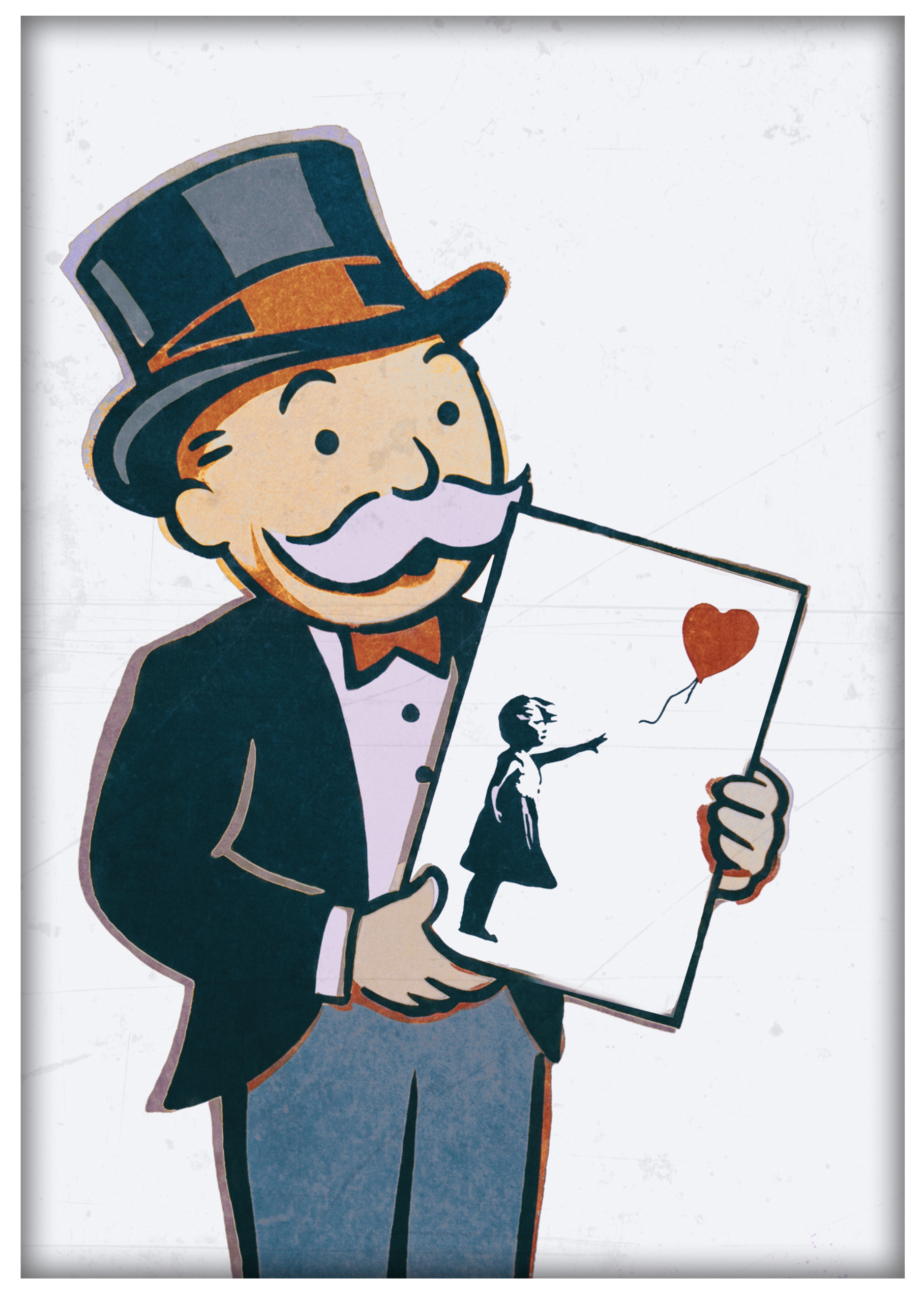
Warum wir keine schönen Dingen haben können

Digital graphic, DIN B1, CMYK print on 170 g/m² paper. 2026.

In his work “Why Can’t We Have Nice Things Anymore?”, Göpel shows us the Monopoly Man in possession of a genuine Banksy. A motif that has by now become part of art history.

Banksy brought his art to the streets. Free of charge, in public, and accessible to everyone. Art that did not have to be purchased in order to be seen. Art that, at least to some extent, escaped the traditional art market.

Of course, that did not last long.

Because the art market is remarkably adaptable. It realized that even art created in opposition to the art market can be sold extremely well.

An image becomes a work of art. The work of art becomes a market value. The market value becomes an investment. And eventually, the investment becomes a return.

And so even Banksy ends up where art can best be protected from the public: in the possession of someone who can afford it.

Or even better, immediately after the auction at Sotheby’s, in a freeport.

There, a work of art can remain for years without anyone having to look at it. It does not get wet, it does not get damaged, and above all, nobody has to entertain the absurd idea of actually hanging it on a wall. The artwork remains safely stored while its value is allowed to keep rising.

Banksy once tried to destroy his work “Girl with Balloon” immediately after an auction he had never intended to participate in. The mechanism built into the frame for precisely this moment, however, failed halfway through its task.

And even this apparent destruction seemed to increase the work’s value once again. For ordinary people, this usually leaves nothing more than the option of looking at reproductions.

You can see the image online, on posters, T-shirts, or coffee mugs. You can read about it, discuss it, and hang a copy on your wall. You just cannot buy the original anymore.

Because the art market has long since transformed the question “Do I like this picture?” into “What will this picture be worth in ten years?”

And with that, the sociocultural perception of art itself changes.

The person who buys a painting because they like it now stands alongside people who buy a painting because they assume someone else will later pay even more for it.

One wants to own something beautiful.

The other wants to own an asset.

And the market has decided which of the two matters more.

Perhaps that is the real joke about Banksy.

An art form that was once intended to be seen by everyone becomes an investment vehicle for the few. What was free on the street becomes unaffordable at auction and subsequently disappears, in many cases, into private storage for decades.

Art degenerates into a speculative asset for the wealthy and reveals the most vulgar form of capitalism. Absurd prices are paid for paintings that are then removed from public view for extended periods of time.

Should the acquired work eventually be loaned to a museum, the public has been lucky – although alongside the artist’s name, it must now also admire the name of the generous lender, who, without producing any art of their own, suddenly finds themselves hanging in the museum as well.

Vandalismus 2.0

PLA 3D print, painted. 2026.

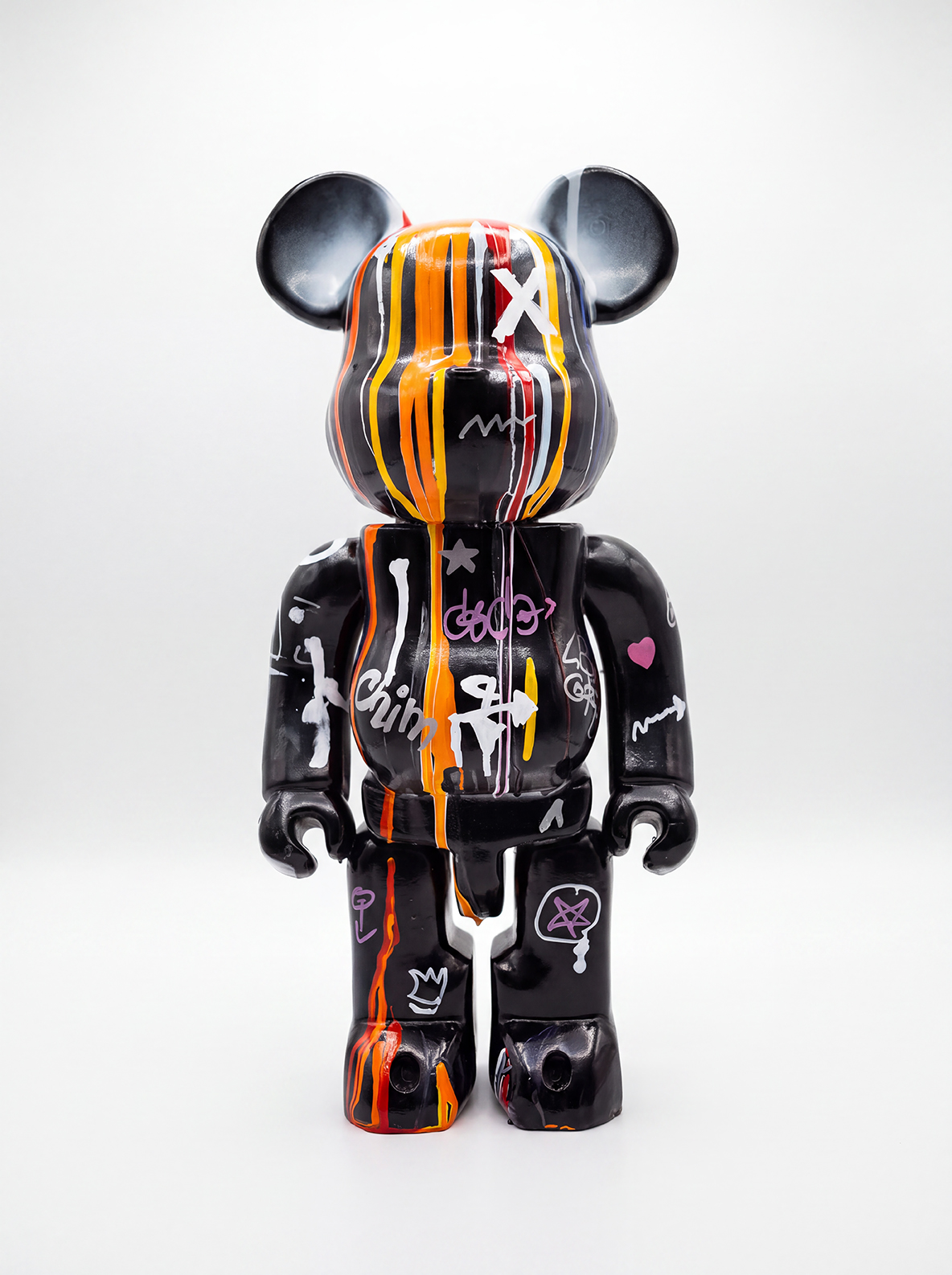
Göpel’s 3D-printed Bearbrick has been smeared, tagged, and covered in paint.

Is this vandalism, or does it already constitute art within this visual language? Or is it simply a mass-produced plastic figure that has been transformed into a unique object through graffiti-like markings and therefore assigned artistic value precisely because of its uniqueness?

Should we understand these subcultural tags as an elevation of the work, or are they, as they would be perceived in public space, simply a form of disruption?

Perhaps this very ambiguity is the true appeal of the work.

What might have been intended as destruction simultaneously alters its meaning, transforming an industrially reproducible object into a one-of-a-kind piece that can no longer be reproduced in exactly the same form.

The traces of paint reveal as much about the intervention as they do about the original object, which increasingly disappears beneath them. The act of covering and tagging the figure thus becomes an artistic process in itself, even though it may never have been intended as such.

Where does appropriation end, and where does damage to a work of art begin?

And who actually decides whether an alteration constitutes an increase in value or an act of destruction? Perhaps the Bearbrick is ultimately interesting precisely because it can no longer be assigned an unambiguous place between consumer object, vandalism, and art.

This also makes its position within the art market relevant:

Can the destruction of a mass-produced consumer object actually increase its market value by transforming it into a supposedly unique work of art?

The commercialization of art thus turns appropriation, damage, and individualization into potentially tradable forms of value, transforming even the act of destruction into a form of value creation.

What was originally conceived as a cheap, reproducible consumer product is thereby culturally elevated by the art world and, ultimately, made potentially valuable precisely through that transformation.